

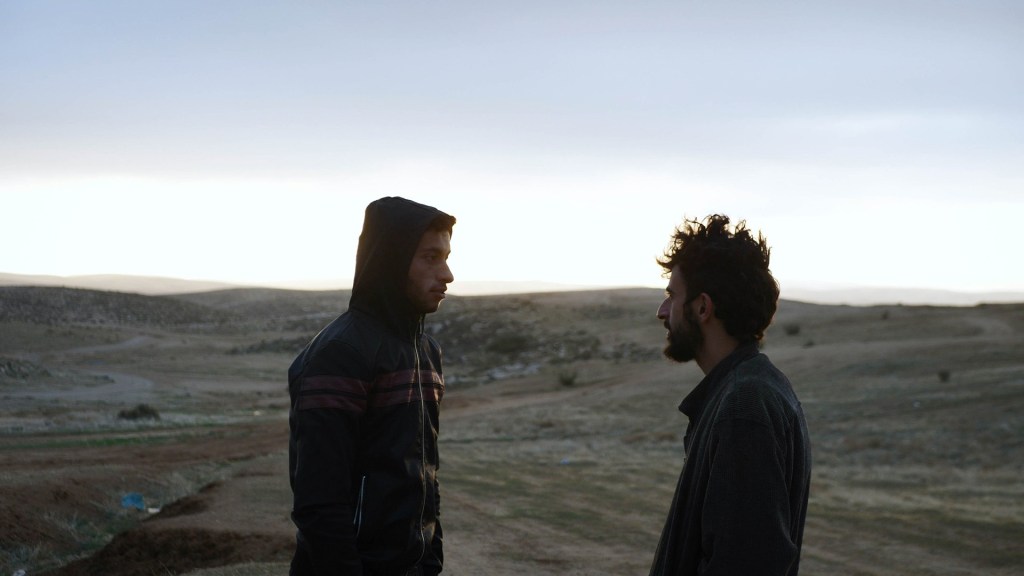
- Five Cent Cine: No Other Land by 2 Film Critics
- Movie Review (NYFF 2024): ‘No Other Land’ is the Year’s Most Vital and Gutting Film by Will Bjarnar
- No Other Land by Jordan Canahai
- No Other Land review by Jared Mobarak
From our 2024 Awards Ceremony:
Jordan Canahai on No Other Land winning Best Documentary.
Martin Scorsese once said, “Now more than ever we need to talk to each other, to listen to each other, and understand how we see the world, and cinema is the best medium for doing this.” With that in mind, the five works nominated for Best Documentary are all unified by their exemplary filmmaking, by the sincerity of their creator’s vision, and by their desire to help viewers better understand the lives they offer a glimpse into.
No Other Land, directed by the Palestinian/Israeli collective of Basel Adra, Hamdan Ballal, Yuval Abraham, and Rachel Szor, is a harrowing and at times heartbreaking documentary of both urgency and hope which depicts the ongoing destruction of the occupied West Bank by the Israeli military from the perspective of those most directly impacted.
For director and young Palestinian activist Basel Adra, No Other Land could be described as a lifelong labor as he had been protesting the forced displacement of his people in the region of Massafer Yatta since he was a child. Documenting the Israeli military as they tear down homes and forcibly evict their inhabitants, Adra would find an unlikely ally in Israeli journalist and fellow peace activist Yuval Abraham. It is crucial that the driving creative forces behind this documentary were Palestinian and Israeli. This speaks to how there are peacemakers on both sides speaking out against the ongoing conflict in the region, and No Other Land is a richer and more profound film for this collaboration.
Despite this, the film also takes pains to show that, while cooperation between Israelis and Palestinians is possible and necessary to achieve peace, there is a huge gap in their living conditions. Basel lives in a state of constant oppression and struggle while Yuval does not. In other words, the Israeli filmmakers are activists by choice while the Palestinians are activists by circumstance.
Adra and Abraham would work closely on production of No Other Land for four years from October 2019 through its completion in October 2023, precisely when the Hamas/Israel conflict would intensify following the events of October 7th—making the film even more timely and relevant.
No Other Land is not a particularly revolutionary documentary in terms of its approach to narrative. Nor is it a very flashy one stylistically. What makes it essential viewing and the best documentary of 2024 is that it offers a first-hand glimpse into the suffering of an entire ethnic community while demanding justice and accountability for those responsible. There wasn’t a more noble use of the documentary form all year.
Jordan Canahai on No Other Land winning Best Foreign Film.
Oscar-winning South Korean filmmaker Bong Joon Ho once famously said, “Once you overcome the 1-inch tall barrier of subtitles, you will be introduced to so many more amazing films.” And the five films nominated for Best Foreign Language Film are proof of that.
Last year I had the opportunity to announce the Best Foreign Language Film of 2023—Jonathan Glazer’s unorthodox Holocaust drama The Zone of Interest. Academy voters would agree with our selection as the film went on to win the Oscar for Best International Feature as well. In his speech, Glazer boldly used his time to address the conflict in Gaza, saying, “Right now, we stand here as men who refute their Jewishness and the Holocaust being hijacked by an occupation which has led to conflict for so many innocent people. Whether the victims of October 7th in Israel or the ongoing attack on Gaza—all the victims of this dehumanization, how do we resist?”
I certainly don’t have a definitive answer to that question, but I do think I know an act of resistance when I see one. No Other Land is an act of resistance. An urgent call from both Palestinian and Israeli activists to end the conflict and occupation which has brought bloodshed on so many innocent lives.
While critics like myself and those I’m fortunate to share this stage with often like to speak about art’s ability to change the world in positive terms, the cynic (or perhaps even the realist) in me believes that, despite such platitudes, art is not particularly good at changing the world. If it was I’d like to believe the barbarism that defined much of the 20th century would not still be happening in the 21st. What I do think art is good at, however, is helping us make sense of the present moment. And no other film in the past year has helped us make better sense of the ongoing genocide in Gaza than No Other Land. For that reason, we felt it worthy of winning both Best Documentary and Best Foreign Language Film.
 Greater WNY Film Critics Association
Leave a comment